
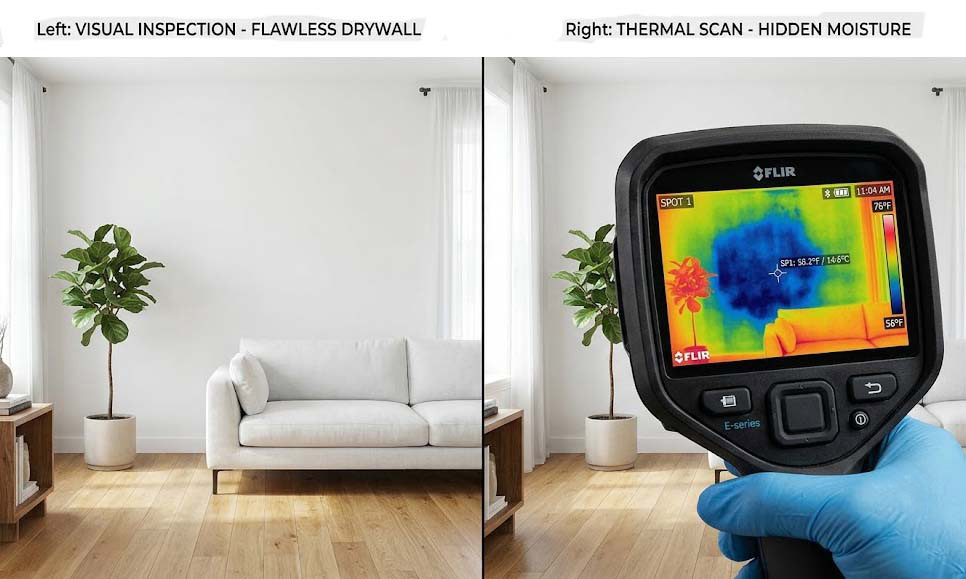
Hidden water damage in Florida homes typically manifests through four subtle warnings: faint musty odors that persist despite running the AC, unexplained spikes in your monthly municipal water bill, localized buckling or soft spots on baseboards and drywall, and bubbling or peeling paint. Because of Southwest Florida’s intense humidity, a concealed pipe leak behind drywall or under a concrete slab can trigger toxic black mold colonization within 48 hours. If you detect any of these anomalies, immediate professional leak detection and thermal moisture mapping are required to prevent catastrophic structural rot.
When a major hurricane hits or a water main ruptures, water damage is impossible to ignore, you see the standing water, you know the emergency, and you call for extraction immediately.
However, the most financially devastating property losses in Southwest Florida rarely start with a massive flood. Instead, they begin with a silent, hidden structural failure, a pinhole leak in a copper pipe behind your custom kitchen cabinets, a slow hairline crack in a master bathroom shower pan, or a compromised flashing seal on your roof.
In Cape Coral’s subtropical environment, moisture behaves aggressively. By the time a hidden leak finally breaks through to create a visible puddle, the interior of your walls may already be ruined by wood rot, compromised framing studs, and toxic black mold. Recognizing the early, microscopic indicators of hidden moisture is your only defense against a massive, out-of-pocket remediation bill.
(Developer Note: Insert a contextual internal link to the Cluster’s Pillar Page here).
Unsure how to handle a sudden, widespread moisture emergency? Read our Complete Guide to Flood Damage Restoration & Rebuilding in Cape Coral to protect your property step by step.
1. The Visual Red Flags: What Your Walls Are Trying to Tell You
Drywall is incredibly porous. It acts like a sponge, drawing water upward against gravity through a process called capillary action. However, because the front of your drywall is sealed with layers of primer and latex paint, the water stays trapped inside the wall cavity for weeks before it completely breaks through.
Look for these subtle visual anomalies along your walls and ceilings:
- Bubbling, Flaking, or Peeling Paint: When moisture saturates the gypsum core of drywall from the backside, it destroys the adhesive bond between the drywall paper and the latex paint coat. If your paint looks like it is blistering or peeling away near the baseboards, water is present.
- The Faint “Teardrop” Stain: On ceilings, hidden roof leaks or second-floor plumbing failures rarely initially manifest as a rushing waterfall. Look for faint, yellowish-brown rings that slowly expand over time.
- Warping and Crowning Trim Boards: Baseboards and crown moldings made of MDF (Medium-Density Fiberboard) or solid wood will warp immediately upon contact with moisture. If you notice your baseboards pulling away from the drywall or showing a slight “curve” (crowning), water is pooling beneath your subfloor.
2. The Olfactory Signal: The Unmistakable Smell of Mold
Your eyes can be deceived, but your nose cannot. One of the most accurate indicators of hidden water damage in Southwest Florida is a persistent, earthy, or musty odor in a localized area of your home.
Why the AC Doesn’t Fix It
Many homeowners assume that running their central air conditioning system on high will pull enough humidity out of the air to stop mold growth. While a properly sized AC unit manages ambient indoor humidity, it cannot circulate air inside sealed wall cavities or underneath built-in cabinetry.
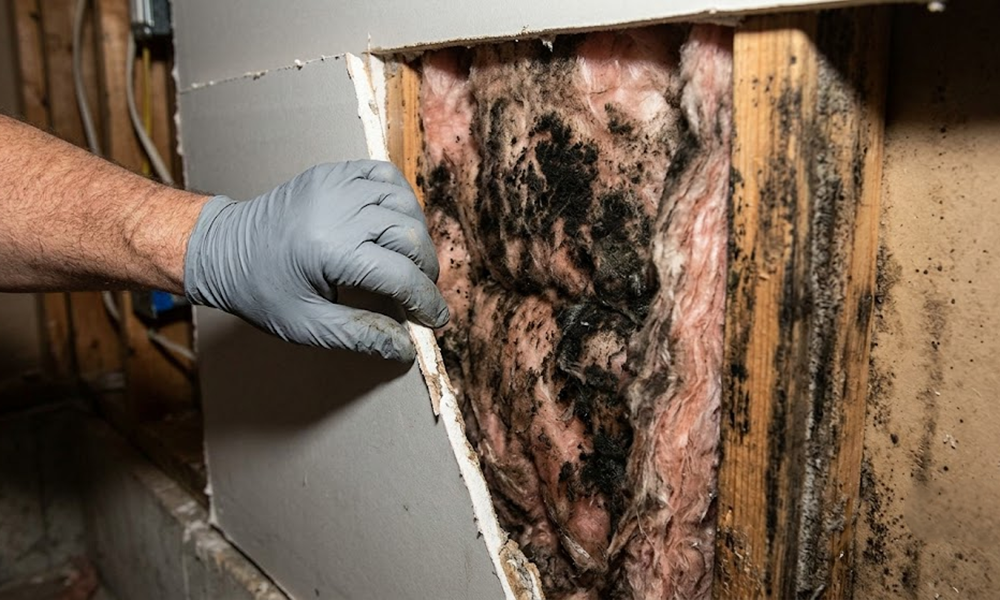
If a specific room, closet, or kitchen pantry smells like damp cardboard or a wet basement, even when the rest of the house feels crisp and cool, you are likely smelling a hidden colony of Stachybotrys chartarum (black mold) or Aspergillus thriving on the damp, dark paper backing of your drywall studs.
3. The Financial Indicator: Tracking Your Water Utility Bill
Sometimes, the first sign of a hidden water disaster doesn’t appear inside your home at all; it appears in your email inbox via your monthly utility statement.
Every homeowner should establish a baseline for their average monthly water consumption through the City of Cape Coral or Lee County Utilities. If your household habits have not changed (no extra guests, no filling of the swimming pool, no increased lawn irrigation), but your water bill shows a sudden, unexplained jump of 2,000 gallons or more, water is escaping your system somewhere.
The Slab Leak Threat
In Southwest Florida, many homes are built on slab-on-grade foundations, meaning the copper or PEX water supply lines run directly beneath or inside a thick concrete slab. A pinhole leak in a pipe under the concrete will not create an immediate puddle. Instead, the water will pump directly into the soil beneath your home, washing away the foundational dirt (causing structural settling) while slowly wicking upward into your floor tiles or luxury vinyl plank (LVP) flooring from below.
4. The Auditory Clues: Listening to Your Home at Night
When the television is off, the kids are asleep, and the ambient noise of the day settles down, take a moment to listen to your plumbing infrastructure.
If you hear a faint, rhythmic ticking sound, a persistent low hiss, or the sound of rushing water behind a bathroom wall when no appliances or faucets are running, you are listening to an active leak.
The Quick Test: Go to your home’s main exterior water meter box near the street. Wipe the glass face clean and look closely at the small red triangle or digital flow indicator (the low-flow indicator). If that dial is spinning or registering water movement while every faucet inside your home is completely shut off, you have a verified leak that requires professional diagnostic intervention.

5. The AMO Excellence Protocol: Non-Invasive Diagnostic and Structural Recovery
If you suspect your home is harboring a hidden leak, do not start smashing through your drywall with a hammer to find it. This unguided approach unnecessarily inflates your eventual repair costs and can accidentally puncture live electrical lines or sewer pipes.
AMO Excellence utilizes a non-invasive, scientific protocol to pinpoint hidden moisture without destroying your home’s interior prematurely.
Our Specialized Diagnostic Tools:
- Infrared Thermal Imaging Cameras: Water changes the temperature of building materials. By scanning your walls and ceilings with advanced infrared cameras, we can literally see the exact pattern of moisture migration behind the wall based on heat signatures, mapping the leak directly to its source.
- Pinless Moisture Meters: These tools use electromagnetic signals to measure the precise moisture content inside drywall, concrete slabs, and wood subfloors without poking holes in your premium paint finishes.
- Acoustic Leak Detection: Microphones that amplify the sound of subsurface pipe vibrations, allowing us to find slab leaks under concrete with pinpoint accuracy.
The Complete Restoration and Rebuilding Advantage
Finding the leak is only half the battle. Once a hidden leak is located, the damaged drywall, moldy insulation, or rotted framework must be removed and sanitized.
This is where standard leak detection companies fail; they find the leak, cut a giant, ugly hole in your wall, and tell you to find a builder to fix it.
As a fully licensed General Contracting firm in Cape Coral, AMO Excellence provides a seamless, single-source solution. Our certified mitigation technicians will locate the leak, execute a clean horizontal flood cut to remove only the affected materials, and sanitize the interior framing with EPA-registered biocides, and then our structural division will seamlessly rebuild the space.
Whether your hidden leak requires simple drywall patching or a complete layout redesign with a new custom kitchen installation or bathroom remodel, we manage the permits, the materials, and the craftsmanship from start to finish.
Don’t Let a Slow Leak Destroy Your Investment
A hidden leak will not fix itself; it will only get wider, rot more wood, and spread more toxic spores throughout your indoor air. Protect your home’s equity and your family’s respiratory health before a small drip becomes a major structural emergency.
Contact AMO Excellence today to schedule a professional, non-invasive thermal moisture inspection for your property.